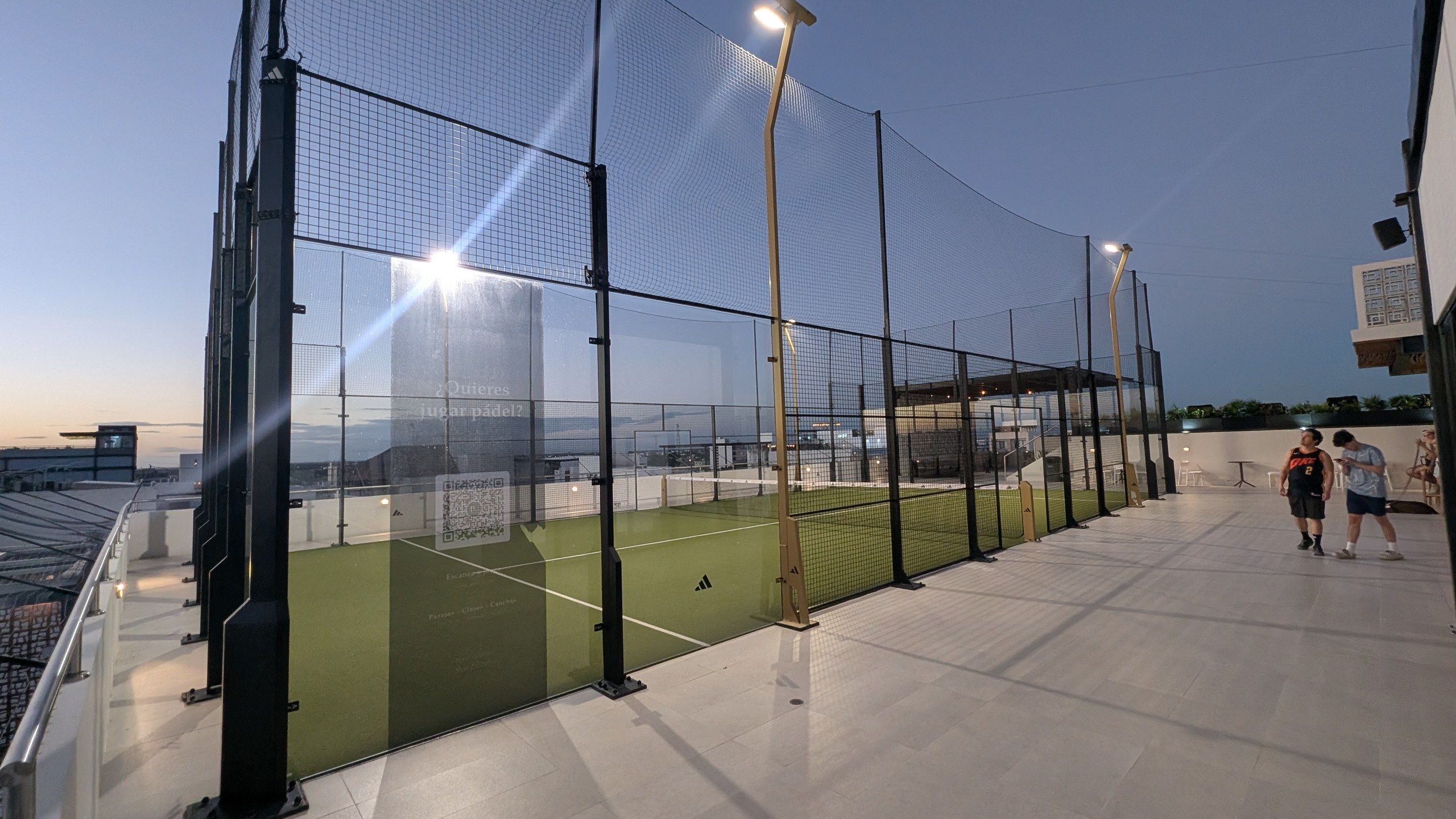
Padel is one of the easiest racket sports to pick up. The court is small, the serve is underarm, and the glass walls keep the ball in play for longer than you'd expect. The rules take a little longer, mostly because of those walls.
This guide covers everything you need for your first game, based on the official rules of the International Padel Federation (FIP), with diagrams for the parts that are easier to see than to read.
Want to try it? Rackets are free at our rooftop court on 5th Avenue in Playa del Carmen. Book a court and bring three friends.
Padel vs tennis vs pickleball
If you've played tennis or pickleball, you already know half of padel. Here's how the three compare.
| Padel | Tennis | Pickleball | |
|---|---|---|---|
| Players | Almost always doubles | Singles or doubles | Singles or doubles |
| Court | 20 m x 10 m, enclosed by walls | 23.77 m x 10.97 m (doubles), open | 13.41 m x 6.10 m, open |
| Serve | Underarm, after a bounce | Overarm | Underhand |
| Walls in play | Yes | No | No |
| Racket | Solid, no strings, with holes | Strung | Solid paddle |
| Scoring | 15, 30, 40, game | 15, 30, 40, game | Games usually to 11, win by 2 |
| How fast to learn | Very quick | Slower | Very quick |
The court and the equipment
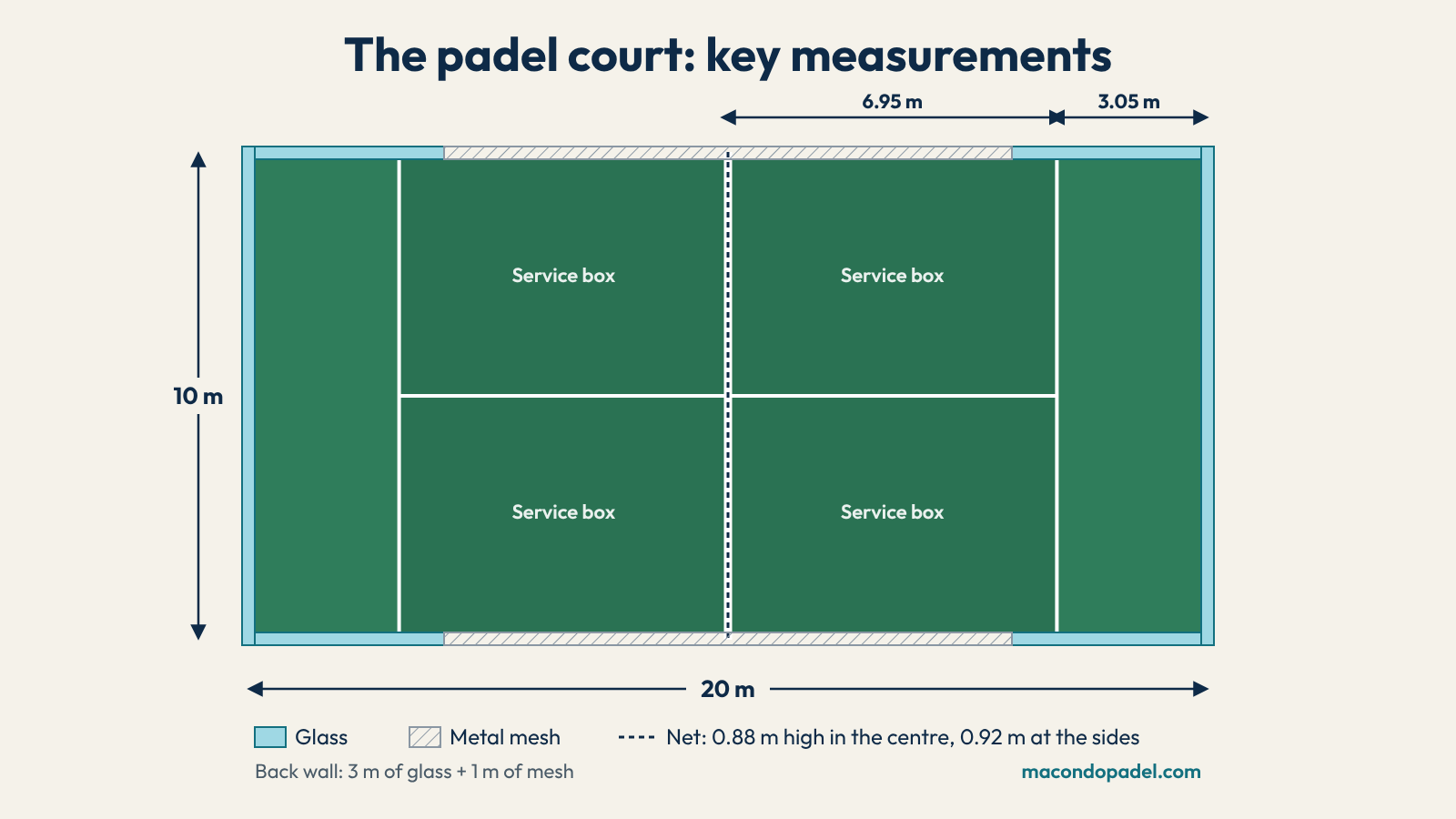
| What | Official size |
|---|---|
| Court | 20 m long, 10 m wide |
| Net | 0.88 m high in the centre, up to 0.92 m at the sides |
| Service line | 6.95 m from the net (3.05 m from the back wall) |
| Back walls | 3 m of glass (or solid wall), with 1 m of mesh above |
| Side walls | Glass for the first 4 m from each end; metal mesh in the middle |
| Racket | Up to 45.5 cm long and 26 cm wide, solid, with holes, no strings |
| Ball | 6.35 to 6.77 cm across, 56 to 59.4 g; it looks like a tennis ball |
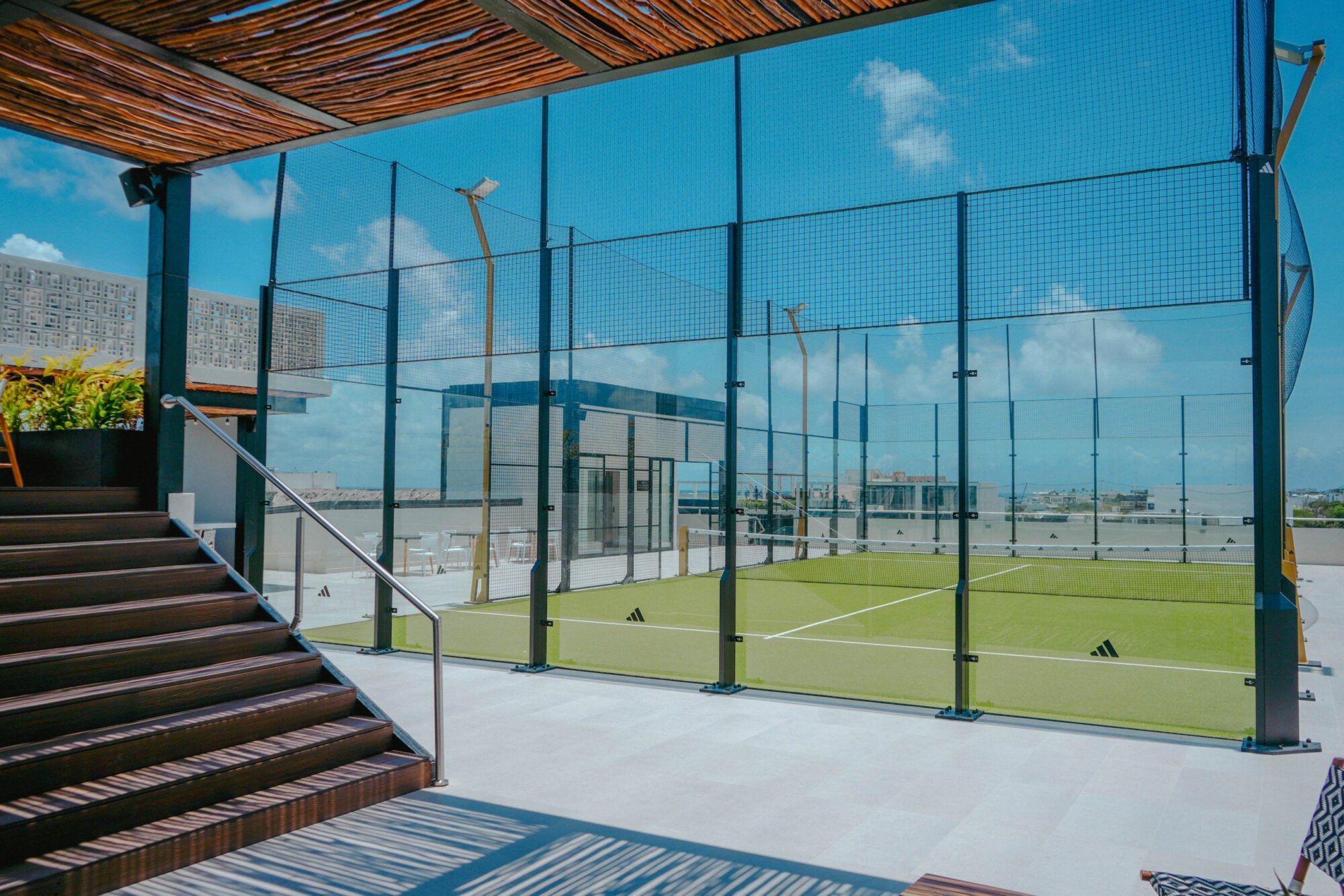
The difference between glass and mesh matters. The ball bounces true off the glass, so you can play it. Off the mesh, it does something unpredictable, and on the serve, hitting the mesh is a fault.
How to serve in padel
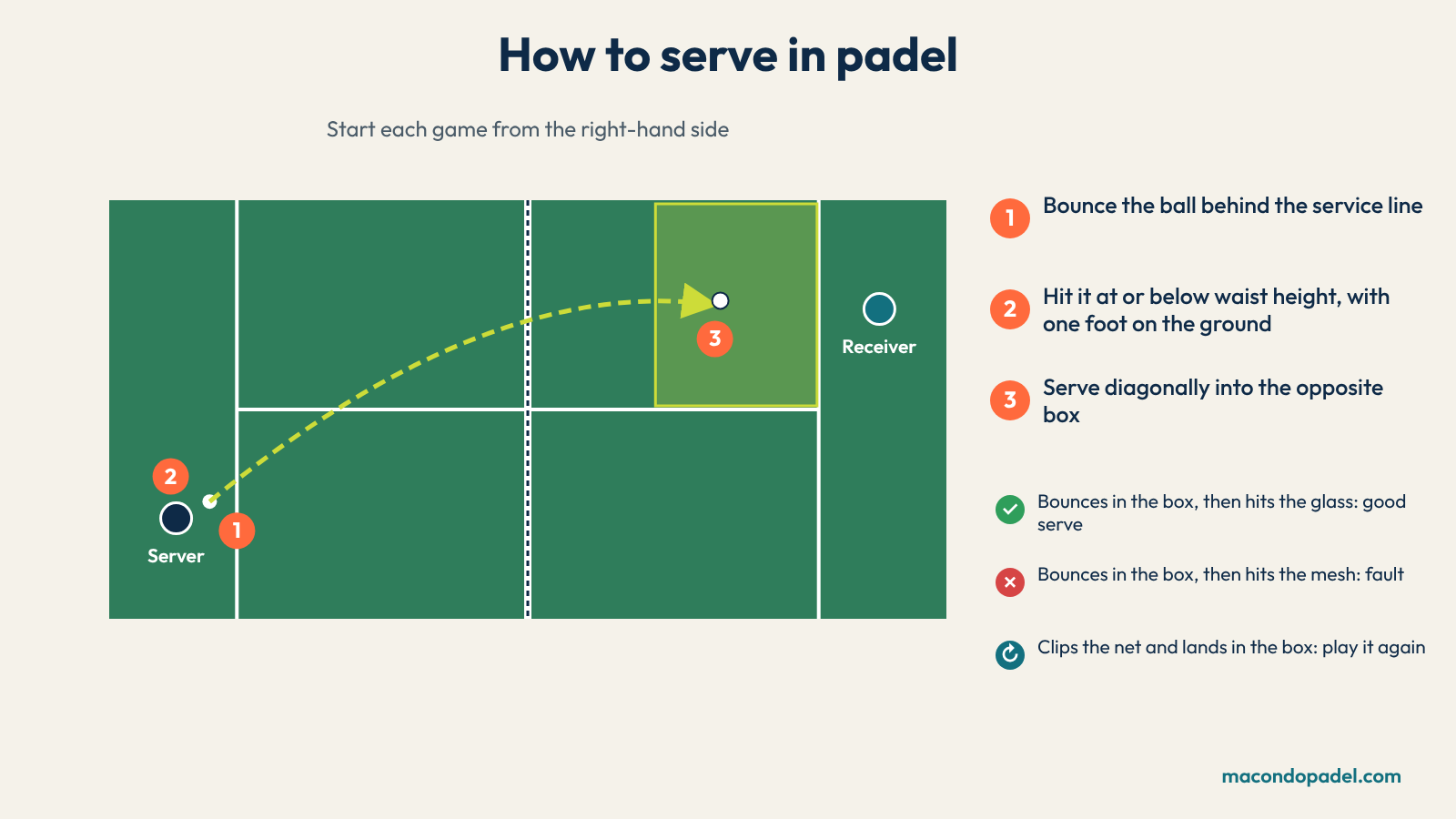
- Stand behind the service line, between the centre line and the side wall. Start each game on the right-hand side, then alternate.
- Bounce the ball on the ground behind the service line.
- Hit it at or below waist height, with at least one foot on the ground. Don't touch the line with your feet.
- Send it diagonally over the net into the opposite service box. Lines count as in.
- You get two serves. Miss both and you lose the point.
| What happens to the serve | Result |
|---|---|
| Bounces in the box, then hits the glass | Good serve |
| Bounces in the box, then hits the mesh | Fault |
| Clips the net, then lands in the box | Let: serve again |
| Clips the net, lands in the box, then hits the mesh | Fault |
| Lands outside the box | Fault |
| You swing and miss the ball completely | Fault |
| Hits you or your partner | Fault |
| Second fault in a row | Point to the other pair |
The returner must let the serve bounce before hitting it. After that, anything goes.
How the walls work
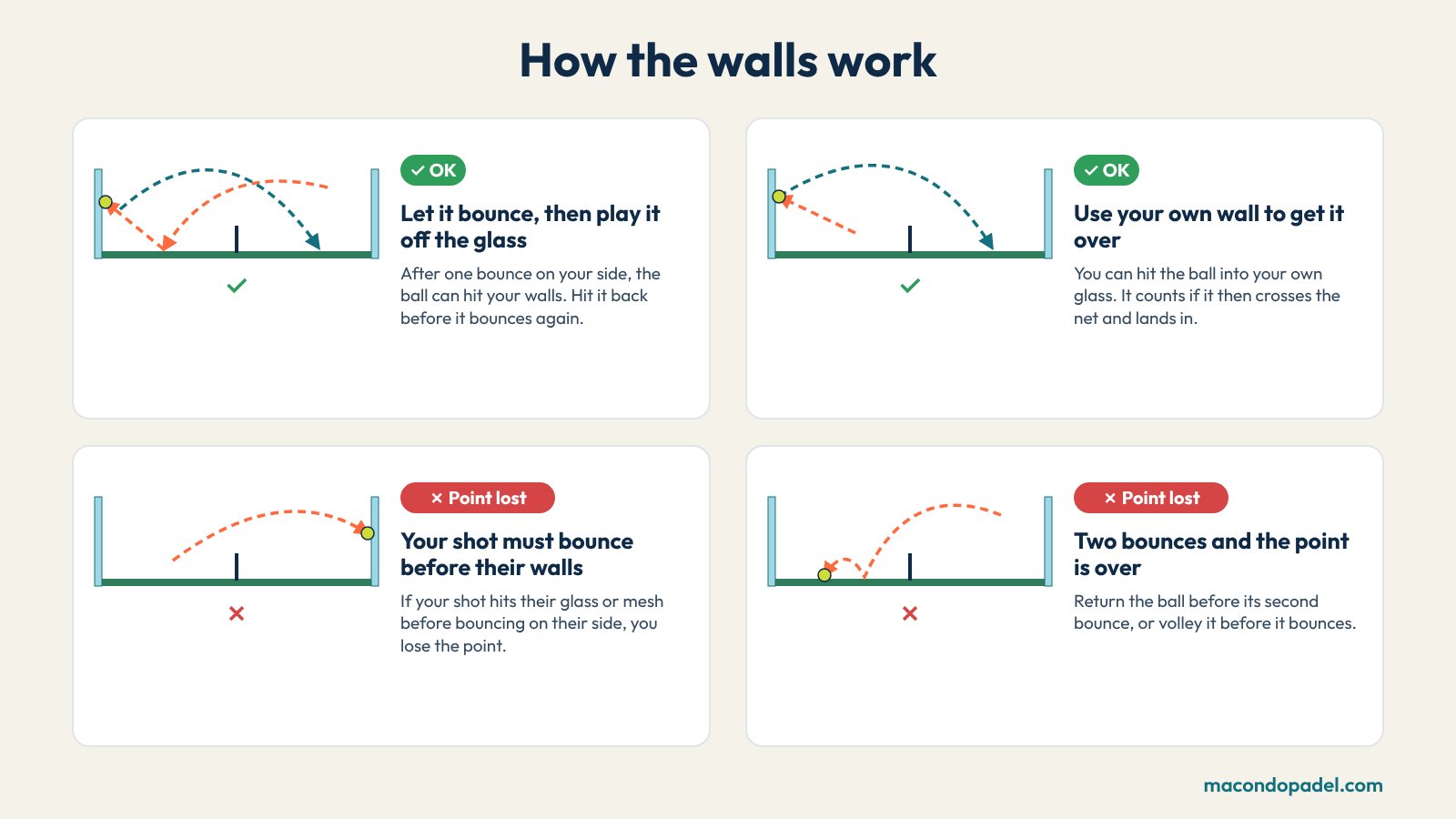
The walls are what make padel feel different. On your side, the ball can bounce once and then hit any wall, and you can still play it. On their side, your shot has to touch the ground before it touches a wall.
| During the rally | Result |
|---|---|
| The ball bounces on your side, then hits your glass or mesh | Still in play: return it before it bounces again |
| You hit the ball into your own glass and it goes over the net | Good shot, as long as it bounces on their side |
| You hit the ball into your own mesh | Point lost |
| Your shot hits their glass or mesh before bouncing | Point lost |
| Your shot bounces on their side, then hits their walls | Good shot: they have to deal with it |
| The ball bounces twice on your side | Point lost |
| The ball hits you or your partner | Point lost |
| You or your racket touch the net | Point lost |
You can volley (hit the ball before it bounces) at any time except on the return of serve. On some courts with open doors and space outside, players can even run out and play the ball outside the court, but that only applies where the court is built for it.
How scoring works in padel
Padel uses tennis scoring. If you've never played tennis, here's the whole thing.
| Points won | What you call it |
|---|---|
| 0 | Love (nada) |
| 1 | 15 |
| 2 | 30 |
| 3 | 40 |
| 4 | Game (if you lead by 2, or win the deciding point) |
At 40-40 (deuce) there are three ways to finish the game. Agree which one before you start.
| Format | How it works at 40-40 | Where you'll see it |
|---|---|---|
| Advantage | Win two points in a row to take the game | Traditional rules, some club matches |
| Golden point | One deciding point; the receiving pair chooses which side receives | Most casual and club games |
| Star point | Play up to two advantages; if it's still level, a deciding point | Professional tours since 2026 |
- Sets: first pair to 6 games, with a 2-game lead. At 6-6, play a tie-break.
- Tie-break: first to 7 points, with a 2-point lead.
- Match: usually the best of three sets. Some clubs replace the third set with a super tie-break to 10.
- Short on time? For a 60 or 90-minute booking, most groups just play games and keep a running score.
The shots to learn first
Padel has its own vocabulary, mostly in Spanish. These are the shots you'll hear about first.
| Shot | What it is | When to use it |
|---|---|---|
| Lob (globo) | A high ball over the players at the net | To push the other pair back from the net |
| Bandeja | A controlled overhead with slice | To answer a lob and keep your place at the net |
| Víbora | A faster, more aggressive overhead with side spin | When a lob gives you time to attack |
| Chiquita | A soft, low ball to the feet of the net players | To force a weak shot and win the net |
| Bajada | An attacking shot after the ball comes off the back glass | When a deep ball bounces high off your back wall |
| Smash (remate) | A full overhead hit hard | To finish the point |
Tips for your first game
- Let the glass do the work. Beginners rush at balls heading for the back wall. Let it bounce, let it come off the glass, then hit it.
- Get to the net together. Pairs who move up and back as a unit win more points.
- Lob more than you think. A good lob over the net players is the most useful shot in padel.
- Talk to your partner. Call "mine" or "yours" on balls down the middle.
- Wear the right shoes. Trainers with a herringbone or clay sole grip best on artificial grass. Avoid running shoes with smooth soles.
- Play early or late in Playa. On an outdoor court, mornings and evenings are much cooler than midday.
Frequently asked questions
Is padel easy to learn?
Yes. It's one of the easiest racket sports to start: the serve is underarm, the court is small and the walls keep rallies going..
Can the ball hit the walls in padel?
Yes, after it bounces on your side. It can then hit your glass or mesh and you can still play it before it bounces a second time. Your own shot must bounce on the other side before it touches their walls.
Can you hit the ball off your own wall in padel?
Yes, into your own glass, as long as the ball then goes over the net and bounces on the other side. Hitting it into your own mesh loses the point.
What is the golden point in padel?
A quick way to finish a game. At 40-40 the next point wins the game, and the receiving pair chooses who receives it. Most casual games use it.
What is the star point in padel?
A scoring format used on the professional tours since 2026. At 40-40 you can play up to two advantages; if the score is still level, one deciding point settles the game.
Can you volley the serve in padel?
No. The returner must let the serve bounce first. After the return, you can volley whenever you like.
Do I need my own racket?
Not at Macondo Rooftop Padel: rackets are free to use (leave an ID at reception), and basic balls are free too. Book a court here.
Play your first game in Playa del Carmen
The best way to learn the rules is to play. Our rooftop court is on the corner of 5th Avenue and Calle 48, open every day from 07:00 to 22:30, with free rackets and free underground parking. Book a court online in a minute, or take a class with our resident coach.
Need players? Our guide to booking padel on Playtomic shows how to join open matches at your level. And if you're comparing courts, here's every padel club in Playa del Carmen.
Source: the official FIP Rules of Padel, edition in force from 1 January 2026. House rules at some clubs may differ slightly, so agree the scoring before you start.
Play on the rooftop on 5th Avenue
Open every day 07:00 to 22:30. Free rackets and parking.